 Customer Service& Support Blog
Cloud Call Center Software Malaysia: Features, Pricing & Setup Guide
article summary:As Malaysia accelerates digital transformation under the My Digital Blueprint, cloud call center software has become a cornerstone of business competitiveness, replacing traditional on-premises systems for its flexibility, cost-efficiency, and scalability. This guide covers key aspects Malaysian businesses need to know—from on-premises vs. cloud comparisons to real-world case studies—helping you make informed decisions.



Table of contents for this article
- 1. On-Premises vs. Cloud Deployment: Key Differences for Malaysian Businesses
- 2. Malaysia’s Cloud Call Center Migration Trends (2026)
- 3. Essential Features for Malaysian Cloud Call Centers
- 4. Deployment Costs (MYR Pricing Range)
- 5. Udesk Call Center Case Study: J&T Express Malaysia
- Final Tips for Setup
- 》》Click to start your free trial of call center, and experience the advantages firsthand.
1. On-Premises vs. Cloud Deployment: Key Differences for Malaysian Businesses
-
Infrastructure & Maintenance: On-premises systems require in-house servers, dedicated IT teams, and regular hardware maintenance—costly and time-consuming for most SMEs. Cloud solutions, by contrast, are hosted by providers, eliminating the need for on-site infrastructure and reducing maintenance burdens significantly. For Malaysian businesses, this means less focus on IT upkeep and more on core operations.
-
Scalability: Cloud systems support elastic scaling—you can add or reduce agents within hours to handle peak seasons (e.g., Ramadan, year-end sales) or business growth. On-premises scaling requires upfront hardware purchases and weeks of configuration, making it inflexible for dynamic markets like Malaysia’s e-commerce sector.
-
Cost: On-premises setups have high upfront costs (MYR 15,000 per agent for hardware/software) and ongoing maintenance fees. Cloud solutions use a pay-as-you-go model, with no upfront investment, making them more accessible for SMEs.
-
Compliance: Both options can meet Malaysia’s PDPA requirements, but cloud providers often offer built-in compliance tools (e.g., data encryption, audit trails) to simplify adherence, while on-premises requires in-house compliance management.
2. Malaysia’s Cloud Call Center Migration Trends (2026)
-
Cloud-Native as Mainstream: Over 65% of Malaysian businesses are migrating to cloud call centers by 2026, with SMEs leading the shift due to low upfront costs and easy setup. Government initiatives like My Digital have accelerated adoption by promoting digital readiness across industries.
-
AI & Omnichannel Integration: Migrations now focus on AI-powered tools (e.g., chatbots, intelligent routing) and omnichannel support (WhatsApp, Facebook Messenger, email) to meet Malaysian consumers’ preference for seamless, multi-platform communication.
-
Localization Prioritization: Businesses are choosing cloud solutions with local language support (Malay, English, Chinese dialects, Tamil) and integration with local platforms (Shopee, Lazada) to better serve Malaysia’s diverse population.
-
Hybrid Models for Transition: Many large enterprises adopt hybrid setups (core data on-premises, agent tools in the cloud) to balance compliance and flexibility during migration.
3. Essential Features for Malaysian Cloud Call Centers
-
Interactive Voice Response (IVR): A must-have for handling high call volumes. Customizable IVR menus (in Malay, English, and local dialects) let customers self-serve for common queries (e.g., parcel tracking, bill payments), reducing agent workload by up to 40%. Advanced IVR can route calls to the right agent based on skill or language.
-
Call Recording: Ensures quality control and compliance with PDPA. Cloud solutions automatically record calls, store them securely, and allow easy retrieval for training or dispute resolution. This is critical for industries like logistics and banking in Malaysia.
-
Real-Time Monitoring: Managers can track agent performance (call duration, wait time, resolution rate) and call metrics (queue length, peak hours) in real time. This helps optimize staffing during busy periods (e.g., e-commerce sales peaks) and improve customer satisfaction.
-
Multilingual Support: Given Malaysia’s multilingual population, software must support Malay (Bahasa Malaysia), English, Mandarin, Cantonese, and Tamil. This ensures agents can communicate effectively with customers, boosting CSAT scores by 20–30%.
-
Omnichannel Integration: Integration with WhatsApp (Malaysia’s most used messaging app), email, and social media platforms allows seamless customer communication across channels. Agents can access a unified customer profile, eliminating the need for customers to repeat queries.
4. Deployment Costs (MYR Pricing Range)
-
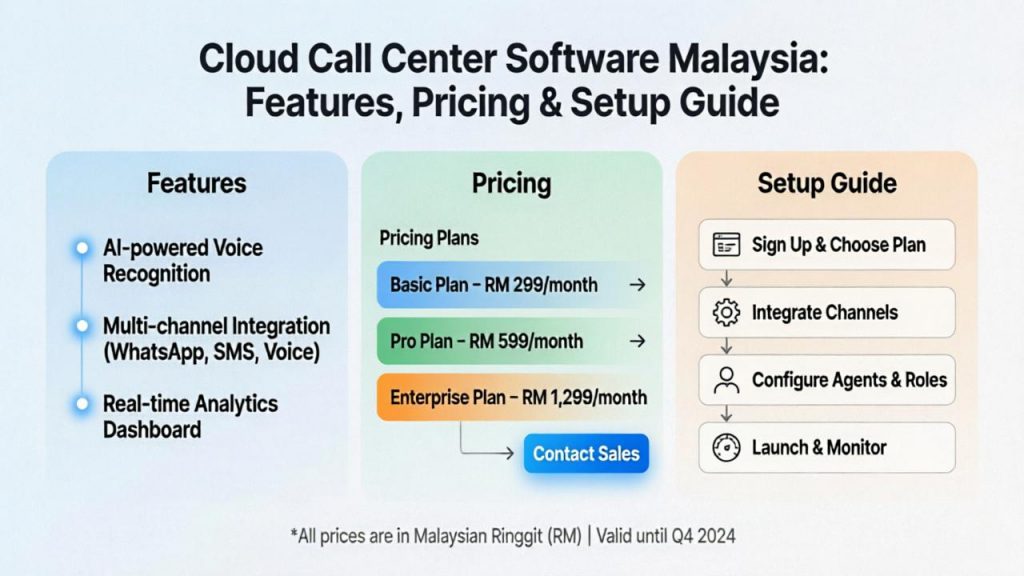
Basic Plan (1–5 Agents): Ideal for small SMEs (e.g., local retailers). Includes core features (IVR, call recording, basic reporting) at MYR 150–250 per agent per month. Total monthly cost: MYR 750–1,250.
-
Standard Plan (6–20 Agents): For growing businesses (e.g., small logistics firms). Adds multilingual support, real-time monitoring, and omnichannel integration. Price: MYR 280–400 per agent per month. Total monthly cost: MYR 1,680–8,000.
-
Enterprise Plan (20+ Agents): For large corporations (e.g., e-commerce platforms, banks). Includes advanced AI tools, custom integrations (e.g., CRM), 24/7 local support, and PDPA compliance tools. Price: MYR 450–650 per agent per month. Total monthly cost: MYR 9,000+.
-
Additional Costs: Setup fees (MYR 500–1,500 one-time), custom integrations (MYR 1,000–5,000), and extra call minutes (MYR 0.10–0.30 per minute for international calls).
5. Udesk Call Center Case Study: J&T Express Malaysia
-
Omnichannel Unification: Integrated WhatsApp, phone, email, and e-commerce platforms (Shopee, Lazada) into a single dashboard, eliminating siloed data. Customers no longer need to repeat queries, reducing complaint rates by 45%.
-
Multilingual Support: Enabled agents to communicate in Malay, English, Mandarin, and Tamil, aligning with Malaysia’s diverse customer base and boosting CSAT to 88%.
-
Real-Time Monitoring & Scaling: Udesk’s real-time analytics helped J&T optimize staffing during peak seasons (e.g., Ramadan), reducing call wait time by 60%. The cloud-based system scaled seamlessly to handle 1.2 million daily queries during year-end sales without additional infrastructure costs.
Final Tips for Setup
With the right solution, Malaysian businesses can leverage cloud call centers to enhance customer experience, reduce costs, and stay competitive in a rapidly digitalizing market.
》》Click to start your free trial of call center, and experience the advantages firsthand.

The article is original by Udesk, and when reprinted, the source must be indicated:https://my.udeskglobal.com/blog/cloud-call-center-software-malaysia-features-pricing-setup-guide.html
Call CenterCall Center Softwarecall center solution