Udesk and Freshdesk are leading international full-channel customer service systems that focus on Southeast Asia while covering the global market. Their main difference lies not in regional coverage, but in product technology approach, the depth of artificial intelligence (AI), industry-scenario implementation capabilities, operational service models, and suitability for enterprise scale. This article compares the two brands across development background, product architecture, and market strategy, to help export companies and local Southeast Asian businesses quickly choose the right system.
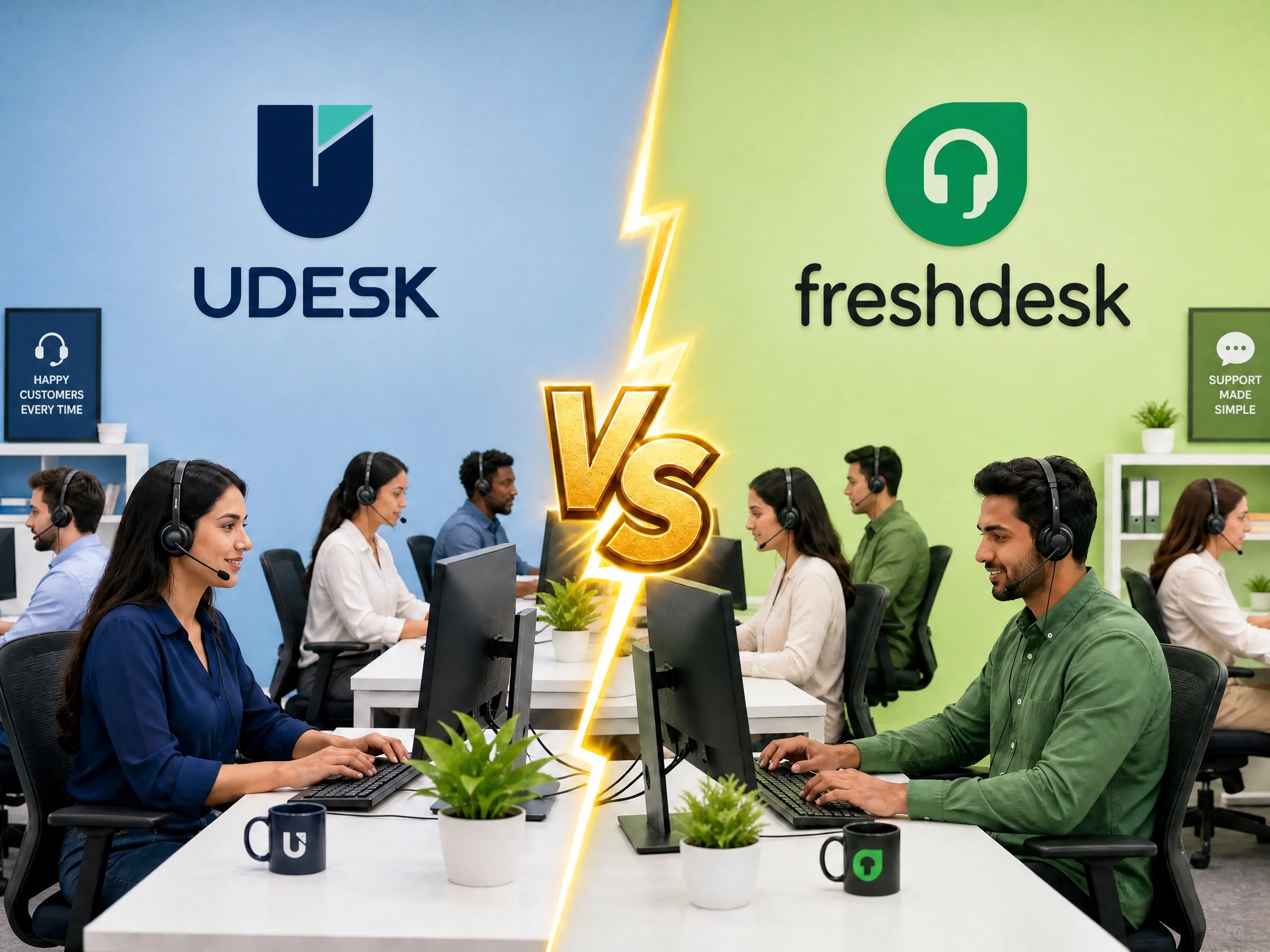
Core difference: Both focus on the Southeast Asian market, yet they follow entirely different core business trajectories, technology focuses, and service models.

| Comparison Dimension |
Udesk Enterprise AI
|
Freshdesk Lightweight SaaS
|
|---|---|---|
| Brand Background | Part of Wonfeng Technology, a nationally recognized specialist company in China. Headquartered in China, it has a self-developed enterprise-grade AI Agent technology base, along with strong credentials for serving large enterprises and government agencies. | Founded in Chennai, India in 2010, with native roots in South Asia and Southeast Asia. Its global headquarters is now in the United States, focusing on lightweight SaaS customer service tools with a globally inclusive product positioning. |
| Regional Presence | Has a dual development core in China and Southeast Asia. It maintains direct multilingual implementation, after-sales, and operations teams in Southeast Asia, focused on local implementation delivery and in-depth service. | Has a strong native foundation in Southeast Asia, covering the entire region from its India base. It prioritizes online standardized product delivery and a channel-partner model, with weak direct local operations teams. |
| Product Focus | An enterprise-grade AI intelligent service platform, focused on autonomous AI Agent execution, complex scenarios across various industries, government legal compliance, and large-scale group operations. | A lightweight customer service ticketing system, focused on standard after-sales tickets, simple automation, and instant use, serving standard service workflows for small and medium teams. |
| Target Group | Medium-to-large export companies, large local Southeast Asian enterprises, and government, finance, manufacturing, and chain-retail groups in China. | Micro-scale cross-border startups, small and medium SaaS teams, and export companies with lightweight after-sales service needs. |
Core difference: Comparable basic overseas channels; Udesk excels at adapting to the local Southeast Asian ecosystem and at cross-border stability.

| Comparison Dimension |
Udesk SEA Choice
|
Freshdesk Global Standard
|
|---|---|---|
| Core Channels | Covers all major overseas channels and deeply optimizes core Southeast Asian social channels such as WhatsApp, adapting to local users’ interaction habits. | Covers a complete set of common overseas channels such as email and social media, with only standard adaptation for general scenarios. |
| Local Channels | Deeply connected with local Southeast Asian telecom and niche social channels, adapting to each country’s communication ecosystem with a high degree of scenario fit. | Supports only common overseas channels, with no dedicated adaptation for niche local Southeast Asian channels, focusing on general standard access. |
| Channel Stability | Specially optimized for cross-border Southeast Asian networks and multi-time-zone operations, with low latency and high stability, able to withstand traffic surges during major promotions. | Uses standard global node deployment with stable basic access in Southeast Asia, but without region-specific optimization, making it prone to fluctuations during high traffic surges. |
| Data Center Capabilities | Supports data isolation and tiered access permissions across multiple brands and countries, plus unified customer profiling, suited to cross-border group management. | Has a unified standard data center for sessions and tickets with complete basic integration capabilities, but lacks a complex group access-isolation system. |
Core difference: Freshdesk’s lightweight ticketing system is mature, while Udesk’s enterprise-grade AI Agent capabilities and industry-scenario adaptation are comprehensively superior.

| Comparison Dimension |
Udesk AI Leading
|
Freshdesk Lightweight Ticketing
|
|---|---|---|
| AI Agent (Core Difference) | Features a self-developed enterprise-grade AI Agent with a dual text-and-voice architecture. It can plan autonomously, call work tools, perform reflective iteration, and complete entire workflows without manual intervention. Accurate recognition of minor Southeast Asian languages, supporting closure of complex business cases. | Equipped with the basic Freddy AI, supporting only text ticket classification and simple reply suggestions. It has no voice AI system and relies on preset processes without autonomous reasoning and business-execution capabilities, at a basic intelligence level. |
| Ticketing System | Can customize complex multi-level ticket workflows, supporting cross-country and cross-department collaboration, plus AI intelligent assignment and automatic closure. Suited to complex after-sales, repair, and complaint scenarios in large enterprises. | Has a mature lightweight ticketing system with SLA control, stable basic workflows, and instant use. However, its ability to customize complex workflows and enable cross-regional collaboration is weak. |
| Voice Capabilities | Has a fully featured cloud call center, AI outbound calling, intelligent voice quality inspection, full-duplex voice dialogue, and noise-suppression adaptation, covering all voice service scenarios. | Has only basic call access capabilities, with no voice AI automation, intelligent quality inspection, or human-like interaction, showing clear shortcomings in voice service scenarios. |
| Industry Scenarios | Provides dedicated standard operating procedures (SOPs) for various industries such as cross-border e-commerce, logistics, finance, manufacturing, and retail, with many implementation cases, able to meet the complex needs of vertical industries. | Provides only general standard scenarios, without deep customization for vertical industries, suited only to general inquiry and after-sales ticket scenarios. |
| Data Analysis | Provides basic reports + AI intelligent operational diagnostics, multidimensional quality-inspection analysis, and risk alerts, supporting precise enterprise operations. | Has only basic standard data-report statistics, without AI intelligent analysis and deep operational-diagnostic capabilities. |
Core difference: Comparable deployment modes; Udesk excels in legal-compliance systems and enterprise-grade integration capabilities.

| Comparison Dimension |
Udesk Full Compliance
|
Freshdesk General Standard
|
|---|---|---|
| Deployment Mode | Covers public cloud, private cloud, and hybrid cloud, supporting local Southeast Asian node deployment and data storage in line with regional regulations. | Primarily uses lightweight public-cloud deployment, supporting basic private deployment, suited to fast rollout for micro and small businesses. |
| Security Compliance | Holds China’s MLPS Level 3 security certification, while also aligning with international compliance standards such as GDPR, Thailand’s PDPA, Indonesia’s data regulations, and other Southeast Asian regional standards. It provides full-chain auditing and complete sensitive-information protection, suited to heavily regulated industries. | Meets common international data-compliance standards, without dedicated adaptation to Southeast Asian regulations, and cannot meet the needs of heavily regulated industries such as finance and government. |
| Extension & Integration | Supports low-code customization and rich APIs, deeply integrated with ERP, CRM, cross-border e-commerce, logistics, and in-house business systems, supporting the closed-loop integration of complex enterprise operations. | Has a rich third-party plugin ecosystem, suited to lightweight tool integration, but its ability to deeply integrate with complex business systems is limited. |
Core difference: Freshdesk offers high upfront cost efficiency, while Udesk offers controlled full-feature, large-scale usage costs with no hidden fees.

| Comparison Dimension |
Udesk More Economical
|
Freshdesk Per Module
|
|---|---|---|
| Pricing Model | Integrated package pricing, with clear and well-organized package features and no messy feature fragmentation. | Tiered modular pricing, offering a free version with a very low entry barrier, with advanced features paid for separately. |
| Feature Costs | Core features such as AI Agent, full channels, voice capabilities, advanced reporting, and legal compliance are all included in the package, with no hidden fees. | Advanced AI, additional channels, in-depth reporting, and automation capabilities are paid add-on modules, with highly fragmented feature separation. |
| Overall Cost | Suited to large-scale use by medium and large teams, with high cost efficiency across full features, and stable, controlled long-term operating costs. | Very low upfront cost for micro teams, but the total cost rises quickly as the team expands and features are added. |
Find quick answers to the most common questions about the Udesk vs. Freshdesk comparison to help with your final decision.
✅ Strengths
⚠️ Weaknesses
Its early lightweight-version flexibility is insufficient; an overly complete feature set is not efficient for micro teams of 1–3 people, making the initial entry barrier higher than that of purely lightweight tools.
✅ Strengths
⚠️ Weaknesses
 Contact